
These are the 15 four-year colleges in Texas with at least 1,000 undergraduates and the lowest average net price after grants. Texas A & M International University is the lowest at $336 a year.
- $336 after grants$14,117 sticker
- $4,858 after grants$17,358 sticker
- $5,070 after grants$21,032 sticker
- $6,803 after grants$17,245 sticker
- $7,984 after grants$21,777 sticker
- $8,115 after grants$21,353 sticker
- $9,828 after grants$18,864 sticker
- $9,872 after grants$24,626 sticker
- $11,060 after grants$22,820 sticker
- $11,164 after grants$87,824 sticker
- $11,439 after grants$23,250 sticker
- $11,793 after grants$23,601 sticker
- $11,852 after grants$24,931 sticker
- $12,111 after grants$23,816 sticker
- $13,212 after grants$25,774 sticker
| College | |||||||||
|---|---|---|---|---|---|---|---|---|---|
| 1.Texas A & M International University Laredo, TX · Public | $14,117 | $336 | — | $2,810 | $9,141 | $4,165 | $6,554 | 44.4% | 48% |
| 2.The University of Texas Rio Grande Valley Edinburg, TX · Public | $17,358 | $4,858 | $3,980 | $3,681 | $4,614 | $7,274 | $14,327 | 94.2% | 53% |
| 3.The University of Texas Permian Basin Odessa, TX · Public | $21,032 | $5,070 | $4,785 | $7,384 | $8,835 | — | — | 94.9% | 40% |
| 4.The University of Texas at El Paso El Paso, TX · Public | $17,245 | $6,803 | $5,623 | $5,519 | $6,329 | $9,704 | $16,291 | 99.9% | 50% |
| 5.Lamar University Beaumont, TX · Public | $21,777 | $7,984 | $7,196 | $6,276 | $6,834 | $9,623 | $14,931 | 86.4% | 38% |
| 6.Texas A&M University-Victoria Victoria, TX · Public | $21,353 | $8,115 | $5,327 | $5,500 | $17,520 | $20,053 | $21,242 | 95.9% | 24% |
| 7.University of Houston-Downtown Houston, TX · Public | $18,864 | $9,828 | $8,865 | $8,824 | $9,953 | $12,069 | $17,444 | 90.0% | 32% |
| 8.The University of Texas at San Antonio San Antonio, TX · Public | $24,626 | $9,872 | $7,752 | $7,302 | $7,920 | $14,051 | $20,648 | 86.8% | 52% |
| 9.Texas Woman's University Denton, TX · Public | $22,820 | $11,060 | $9,412 | $9,135 | $9,458 | $13,920 | $19,219 | 96.1% | 49% |
| 10.Rice University Houston, TX · Private nonprofit | $87,824 | $11,164 | $5,707 | $1,524 | $5,420 | $14,522 | $40,188 | 8.0% | 95% |
| 11.University of Houston Houston, TX · Public | $23,250 | $11,439 | $8,468 | $8,553 | $8,529 | $13,799 | $21,065 | 73.9% | 65% |
| 12.Midwestern State University Wichita Falls, TX · Public | $23,601 | $11,793 | $10,505 | $11,036 | $10,040 | $12,755 | $19,624 | 93.5% | 42% |
| 13.University of Houston-Clear Lake Houston, TX · Public | $24,931 | $11,852 | $9,544 | $9,042 | $10,826 | $16,388 | $18,171 | 90.5% | 48% |
| 14.University of North Texas at Dallas Dallas, TX · Public | $23,816 | $12,111 | $12,036 | $11,515 | $12,360 | $14,753 | — | 84.5% | 40% |
| 15.Texas A&M University-Kingsville Kingsville, TX · Public | $25,774 | $13,212 | $11,387 | $11,288 | $12,131 | $15,978 | $21,587 | 90.9% | 43% |
Average net price is for students receiving federal aid. Very low figures usually mean most students get large grants. Check the college's own net price calculator for your family.
What will these cost your family?
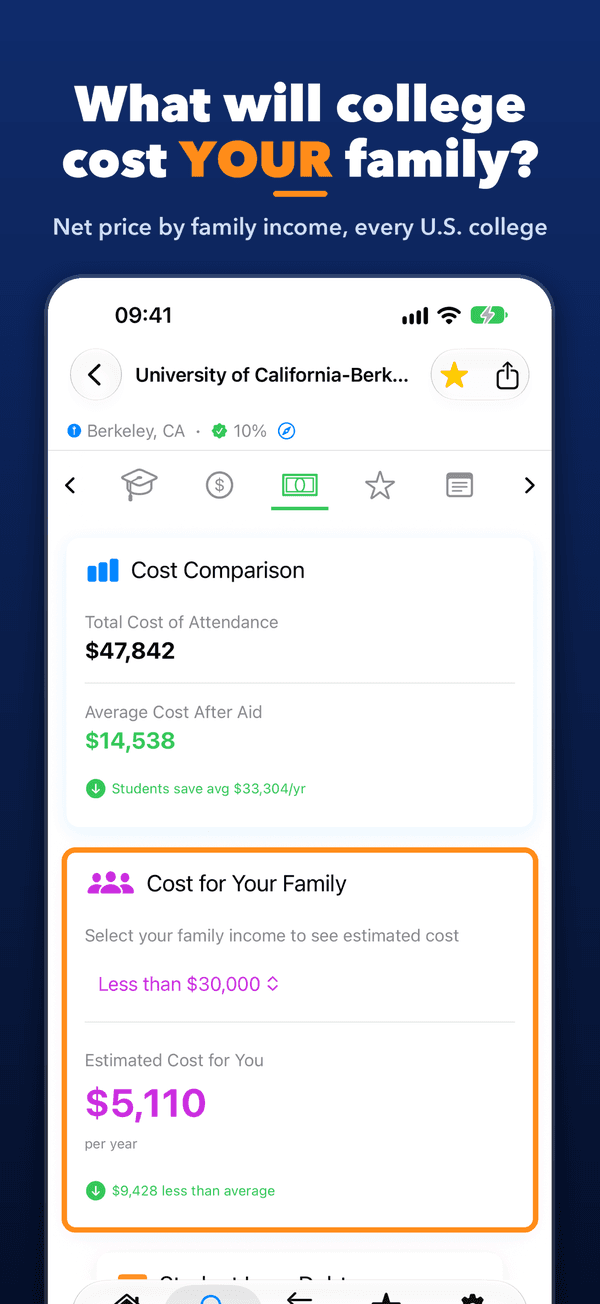
Save the colleges you like and see each one's cost for your family's income, admission rates and deadlines side by side in My College Tracker. Free, no ads.
How to read net price
The sticker price is what a college lists for tuition, housing and the rest. Net price is what students actually paid on average after grants and scholarships, money that doesn't have to be paid back. Loans aren't subtracted. The income chips show the same average for families in each income band: at The University of Texas Rio Grande Valley, the overall average is $4,858 a year, but families earning under $30,000 paid $3,980.
- Sticker pricetuition, housing, food, books
- $17,358
- Grants & scholarshipsaverage, never repaid (approx.)
- −$12,500
- What families paidaverage net price; loans not subtracted
- $4,858
Methodology
- Texas, at least 1,000 undergraduates, with a reported admission and graduation rate.
- Colleges that award mainly bachelor's degrees, currently operating, public or private nonprofit, not online-only.
- Sticker price: the college's full cost of attendance for a year.
- Graduation rate: share of students finishing within 6 years (150% of the normal time).
- Source: U.S. Department of Education College Scorecard, as shown in My College Tracker; data updated Nov 12, 2026.
Questions
What is the cheapest college in Texas after grants?
Among four-year colleges with at least 1,000 undergraduates, Texas A & M International University, at an average of $336 a year after grants.
What does "average net price after grants" mean?
It is what students paid on average for a year (tuition, fees, housing, food, books and other costs) after subtracting grants and scholarships, which don't have to be paid back. Loans are not subtracted: they are part of what a family pays. For public colleges it covers students paying in-state tuition.
Where do these numbers come from?
From the U.S. Department of Education College Scorecard, the same data shown in the My College Tracker app. The income bands are for students who received federal financial aid.
Will my family pay this?
Not exactly: these are averages. What you pay depends on your income, assets and the college's own aid. Each college's net price calculator gives a personal estimate; My College Tracker shows the average for your income band side by side across the colleges you save.
More rankings
Every UC campus, ranked by what families actually pay
UC Merced $11,583 /yr
California universities where families pay under $6K a year
California State University-Los Angeles $2,385 /yr
The cheapest colleges in New York after grants
CUNY Lehman College Under $1,000 /yr
The cheapest colleges in Florida after grants
University of Florida $5,969 /yr
The hardest public universities to get into, and what families pay
UCLA 9.0% admitted
Colleges under $5K a year for families earning under $48K
Brown University Under $1,000 /yr after grants